Quantitative & Qualitative Research

Topography

This is a map of Auckland City. It focuses on Albert Park and the surrounding area. There are two layers to this map. The first is a property titles outline, showing the surrounding buildings and the land they use/take up. Below this, the red lines represent the topography of the land. A topographic map uses contour lines to show elevation, the closer the lines are together the steeper the land.

The red maker represents Albert Park. The left had side of the park looking at it from this perspective has two contour lines rather close this tells us that this area of the park is steep in gradient.

History

The original Maori settlers knew the area as Rangipuke,

The hill on which Albert Park is situated on is volcanic nature. The whole area of Auckland is full of volcanos this particular area was created over 60,00 years ago. It was formed by ash.

  • There was a colonial army base located on site between the years of 1840-1850
  • The Auckland City Council took over the area in 1879 and by 1880 it had become a designated public park.
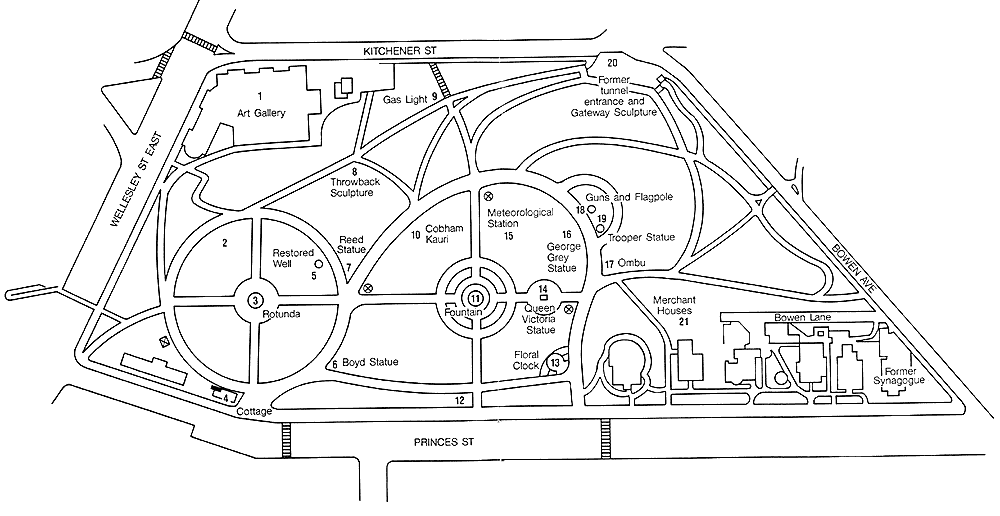
This is a map of the park as we know it today

Tunnels

Albert park has a series of tunnels the run beneath it. These tunnels were built during WW2 as a preventative measure. New Zealand was under threat of a potential invasion and it became aware that something had to be done in order to keep the public safe. The tunnels are actually a purpose built air raid shelter, (they were built with the intention of fitting the entirety of Auckland CBDs population at the time) The main tunnel is 660m long.

Site Mapping Class Exercise

Wed 20.03.19

For todays class we were asked to bring in an A1 piece of paper in order to start our site mapping process. In our table groups of 6-8 we asked to create a single site map collectively. Order to do so we collected together everyones sketches from our Monday site walk and begun to build our map.

We decided that the main thresholds that we wanted to focus on were the ideas of:

  1. Open space – to enclose
  2. Lightness – Darkness
  3. Movement – Stasis

There could also be the possibility to explore the idea of Noisey – Quiet but we decided to stick with 3 to start off with.

based on these themes and ideas this is what we came up with….

We attempted to lay it out in quite a logical way. The bottom right is supposed to represent the entrance into the park, moving up to where the main area where the fountain is located. We tried to include some of the flora and fauna that is found in the park, both native and non-native species. The top left area is mostly about the journey from the park and towards the gallery space. The over bridge connecting the two spaces is rather important because without it access would be much more difficult.

I took away several things from this group exercise. I have decided that I would also light to explore the concept of going form light to dark and also tie this into my previous project where I explored the idea of falling into a dream. Going from the open air and light space of the park to the dark and dimly lit gallery can almost be seen as falling to sleep. The idea of going from a lager and more noisey space into a one thats darker and quiet can be directly linked with the experience of sleeping. 😴

I have taken everything I have learnt into account and will make sure to implement these into my own A1 site map.

PROJECT 2 SLEEP / WAKE: SITE MAPPING: THRESHOLD 30%

18.03.19

Introduction to project 2

In todays class we were introduced to our new project ‘Site Mapping’. This is a continuation on from our previous project where we explored different threshold moments in relation the concept of Sleep/Wake.

St Paul St Gallery 3 is the location of our final presentation. This is located in the WB building on Wellesley St. The Gallery is located in close proximity to Albert Park.

Our first task is map the key thresholds of the gallery site based on our experience of entering and exiting the space.

In the second half of the class we went fro a walk around Albert park exploring the different areas and what it had to offer. Along the way we were told to do a series of quick sketches to help us better understand the way in which it was designed and to help us explore the different threshold moments.

From Albert Park, we made our way towards the gallery space, again thinking about the threshold moments. The building has quite a grand feeling to it, central entrance way with pillars and columns. The actual entrance is raised up from the street level requiring steps to reach it.

Once inside I felt this overwhelming feeling of claustrophobia. The space was dark and cold, dimly lit with a slight echo. In contrast where we had just been (Albert Park) an open space filled with light and life, the gallery space was the complete opposite. Almost like a different world. It’s hard to believe that such different spaces can exist in such close proximity to one another.

Below are several of the drawings I did while out on our walk…

After this class I went away and did some Quantitative and Qualitative research based on Albert park and the Gallery Space. The purpose of finding our this information is help me to better understand the site on both a social, cultural, sensorial and emotional level and also a more measured and factual level.

Our final presentation needs to include:

  1. A1 site drawing / map showing the key thresholds of the gallery site and your experience entering and exiting the gallery space. 
  2. Floor plans (1:50) showing all levels of your proposal: its key features and how it’s put together in relation to the existing building.
  3. A section through your proposal (1:50), showing vertical relationships and assembly in relation to the existing building.
  4. A scale model (1:50) of your SLEEP / WAKE SITE MAPPING: THRESHOLD design.
  5. Regular blog entries which record your design process and decision making

Abstract

SLEEP/WAKE

My concept explores the threshold between Sleep/Wake by looking at and focusing on three main ideas. These ideas include: Movement/Stasis, Dream/Reality and Weight/Weightlessness. The whole idea of my concept is based on falling and what is it to fall asleep? When I think of falling, I think of a vertical movement in a downward motion. When I fall to sleep, I feel myself slowly sinking into the sheets until I finally enter slumber. I wanted to explore the idea of falling into a dream state, the world of our subconscious. The subconscious mind can be a very unpredictable place, what lies within it cannot be controlled. I like to think that it is a happy and peaceful place where the mind goes to rest. I decided to incorporate flora and fauna into my work as a way to represent the nature of the subconscious environment. As dreaming is something that happens within our subconscious, I would associate this with a sensation of weightlessness almost as if you were floating. 

Model 2.0

I went away after Mondays studio and sauced some new materials that related much better to my initial concept and A2 drawing.

I used Balsa Wood to crate the main frame of the model, this is die to the lightness of the material. It has the same properties as foam board but looked much nicer and its also better for the environment!! I also used nylon to suspend it, the purpose of this was to try to create the illusion of weightlessness, that it’s floating in mid air.

Below is some of the process work..

Model Reflection

I took my completed model into studio on Monday the 11th of March. In this class I got the chance to look at what other people had made and I thinking. Im actually not quite happy with how my model turned out.

The concept behind it made sense, however the execution and the the use of materials was not. I wasn’t a fan of the harshness of the black foam board and I also didn’t think that the cellophane plastic looked any good.

Not only did it not look any good, we were told in our Monday studio that the use of plastics in the making of our models is very mush so frowned upon. So that ruled out working with cellophane.

Also I did some research and it turns out that foam board (the main material of my model) is bad for the environment and is not sustainably disposed of.

I reminded myself that I trying to explore the idea of weightlessness, the sense that you are floating. So the use of black foam board doesn’t really make any sense!

So I decided that it was probably best to make another model..

Same concept – Same idea – Just new materials!

Model

Focusing on the idea of falling asleep and falling into a dream state I made this hanging series of squares. They are supposed to represent the girl in my A2 drawing falling and dissipating into a dream.

I used black foam board to construct the main frame of the model and then used coloured cellophane to create an element of transparency.