Porous Walls + Partitions

New District Court House

Baumschlager Eberle ArchitektenJerusalem / Israel / 2014

Above is an example of a Porous wall. This describes a wall that has noticeable gaps/holes throughout. This can be useful for many different situations, especially when wanting to create form without limiting light.

In the same way we think about permeability in regards to the ground and its exposure/ability to filter water, I think the same thinking can be adopted and utilised for lighting and visibility complications. There is nothing worse than a dark, dimly lit space. It makes the space feel confined, when really its just got a low level of light. Natural light is best at creating a welcoming atmosphere that is desired by most.

In an attempt to capture this natural light it would be interesting to include some form of porous wall or partition within the bathhouse proposal. This would allow light to travel continuously throughout the space with less obstruction. Not only would it create the desired atmosphere but it would actually work out to be more environmentally friendly, as less artificial light would be required. Thos relates back to the Te Aranga Design Principal of Kaitiakitanga: managing and conserving the environment as part of a reciprocal relationship, based on the Māori world view that we as humans are part of the natural world.

Organic house – Javier Senosiain

The Organic House designed by javier Senosain is very much so unique. Taking inspiration from a peanut shell, it takes on the form of two oversized ovals. Forms like this wouldn’t usually be associated with a living space and seeing as this was designed back in 1984 Senosiain was before his time.The original concept was defined by two large open spaces, one for day and one for night. Each space incorporated the furniture into the building, for example in the picture above the kitchen bench is simply just an extension of the the curved wall with the sinks being carved out as well.

For me I truly enjoy the organic form of this building, it really connects you back to nature and the environment, in such a way that is still practical and liveable. Organic forms are a really strong to soften a space. Curves are often something that people like to stay away from as they are difficult to work with and usually cause construction cost to increase, but I think that it is important to embrace them and utilise them to their full potential.

I simple way to incorporate curves into an already existing space is waffle frames. This allows curves to be formed out of 2d elements making it easier to work with and construct. I plan to further look into this concept and potentially use it in my proposal.

Disability Access

It is important to consider all walks of life and make sure that the space that you are designing is accessible to all people, catering to all ages and all physical abilities. A large component of this is catering for people who have disabilities.

First of all access into the space needs to be considered. So for example providing lifts and ramps for wheelchair access. In my scenario a lift to cater for not only wheelchair bound people but elderly people who may not be able to take on too many steps. Just providing that extra option if needed is important.

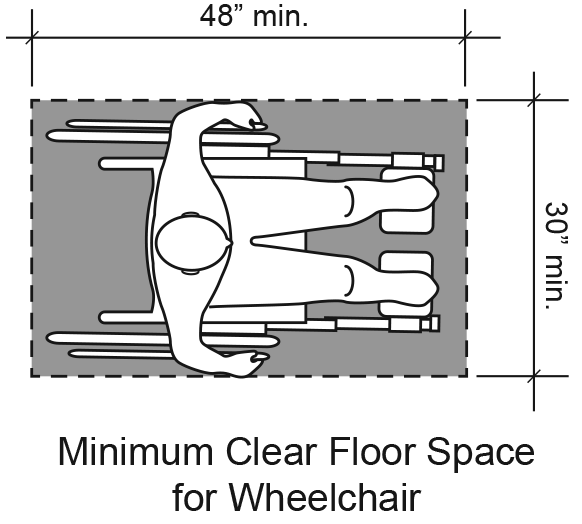
Larger toilet cubicles also need to be considered, especially when it comes to wheelchair access. It is compulsory in all public spaces and venues to provide a larger toilet space that includes aid such as railing around the toilets. Compulsory dimensions for a disabled toilet state that the room needs to be at least 2200mm in length and 1500mm in width. These are of course just the minimum requirements. Dimensions larger than these will give a wheelchair user a larger turning circle, providing greater comfort.

I will make sure to follow these guidelines when it comes to designing the bathroom area. I will also make sure that all hallways and access points are wide enough for both a wheel chair user and another person to pass by comfortably.

Image result for wheelchair access requirements
This diagram is in Inches – converted = 1219.2mm x 762m

Assessment of Infrastructure and earthworks

the current WW basement space in which we have to work with definitely does have its limitations. The main one being the height of the ceiling. It happens to very low and far from ideal. In oder to create pools it would be necessary to excavate downwards to create ample space.

In doing this there are several things that need to be considered. First of all when excavating it is important to ensure that there are no underlying pipes or cables that could be damaged, if so these will need to be re routed prior to works beginning.

The basement space also includes many pillars. These pillars would need to be extended downwards and they serve a structural purpose for the entire building. The pillars will also require base plates to sit upon. Ample excavation space would need to be provided in order to accommodate for these plates. (I have included an diagram to explain this)

Another element to consider is the displacement of soil and the impact that it has on the surrounding environment. What could be done with this soil? Rather than trucking it off site, could dit be reused or repurposed?

In our brief it states that the building is to be converted into apartments for visiting scholars and artists in residence. A possible solution to this soil displacement could be to create some sort of rooftop garden space for the residences to enjoy. Or possibly some sort of AUT garden where students living on site could grow their own fruit and vegetables.

Layout and Floor-plan Experimentation

This is a general layout floor-plan that I made. It shows the different areas of the bathhouse in more detail and allows one to see how people would flow throughout the space.

I decided to incorporate two separate entrances into the bathhouse as it would allow for more flexibly. I thought one entrance could be a members only or that one could be the entrance and one the exit.

The mens and woman’s bathrooms are separated at the moment, however this may change due to space. There is also a separate section for showering off after being the pools.

I have made sure to take into consideration spa goers that may be impeded or have a disability. To cater to their needs I have included a series of ramps in sections where there are stairs and there will be additional space allocated for individuals with wheelchair needs.

I wanted to make sure that the refreshment area was accessible to everyone, even if they were not going to be using the other bathhouse facilities. In doing so I made a clear path down to the area which is located at the rear of the site. I also made this area open to the elements with the sliding doors being able to be fully pushed back creating a borderless transition between the bathhouse space and the forest.

This floor-plan is open to change and will most likely be altered throughout my design process.

Site Model 4.0

After several attempts we finally sorted out our group site model. We made it in such a way so it would be able to incorporate everyones design proposals and ensured that it would be durable enough to withstand being moved around etc..

The main section of the WW building can be removed to reveal the site and our personal proposals.

We still would like to add a photograph of the buildings facade to add context.

WATER!

When is comes to designing a bathhouse space, water is and obviously large component that needs to be taken into consideration. For example things like Filtration, catchment, heating, hygiene, processing and temperature all need to be carefully thought out, with the main objective of providing and creating and peaceful and tranquil environment for spa goers.

Majority of pools these days utilise chlorine to maintain the cleanliness of the pool water. Chlorine is popular, primarily due to the fact that it is relatively cheep and easy to find. However it has some drawbacks, first of all it’s not the best for your skin and it has a rather unpleasant chemical smell.

Due to the fact that I am trying to create a relaxing environment, the last thing you would want is a strong smell of chlorine as you enter space. So I looked into some alternatives to chlorine. (I have listed a couple below)

  • UV Lighting
  • Diatomaceous Earth (DE)
  • PHMB
  • Plants
  • Hydrogen Peroxide
  • Salt Water

Out of all these options, Salt Water filtration is the most appealing. Not only does it rid the water of most bacteria it also has skin nourishing qualities.

Salt water pools use salt, much like the ocean, to keep bacteria out of the water. While salt may not keep your pool totally germ free, it will cut down on the bacteria quite a bit. Salt can also help with skin problems.While these systems and others like them may help eliminate or reduce bacteria in a pool, they are not without additional costs. Weigh your options before making a decision. For some, the cost can outweigh the potential harm from chemicals like chlorine.https://www.diynatural.com/pool-chlorine-alternatives/

This is also in keeping with bathhouses of the pas. In Auckland the Parnell Baths, Tepid Baths and the Point Erin Pools all used salt water at some stage in their history. Although most of them have now turned to chlorine, they still have slat only pools.

Using Salt Water filtration also has much less of an impact on the environment than chlorine. less environmental impact is the overarching goal in the majority of the design decisions made for the bath house, this is in keeping with the Te Aranga Design Principles of Kaitiakitanga and Mauritanga.

So that covers the water filtration and hygiene processing side of things. The next component to consider is temperature.

For the main pool in the bath house I want to make sure that it is comfortable for all spa goers, meaning that it is neither too hot or too cold. I did some research into ideal swimming conditions and this is what I found.

26°C and 28°C is the most common temperature for a residential pool and 36°C and 37°C is the recommended temperature for spa pools. Seeing as this is a bathhouse I think that somewhere between 30°C and 35°C would be ideal for the main pool area. And for the more intimate smaller pools a higher temperature would be more suitable, providing a similar spa like experience.

Another factor to consider is where to source the water from. and how to manage waste water. Upon further inspection, there doesn’t seem to be any underlying waste water pipes within the sites boundaries. I am assuming that this would be a problem and that an existing waste water pipe would need to be extended in order to meet the bathhouse waste requirements.

Rain – By Hone Tuwhare + Drawing

I can hear you
making small holes
in the silence
rain

If I were deaf
the pores of my skin
would open to you
and shut

And I
should know you
by the lick of you
if I were blind

the something
special smell of you
when the sun cakes
the ground

the steady
drum-roll sound
you make
when the wind drops

But if I
should not hear
smell or feel or see
you

you would still
define me
disperse me
wash over me
rain

Hone Tuwhare 1922-2008 

In this poem Tuwhare seems to speaking to the rain as if it is a person. Tuwhare refers to hearing the rain “making small holes in the silence” , as if the heavens were weeping.

In each stanza of the poem Tuwhare references a different sense. For example in the fourth stanza Tuwhare writes, “the something special smell of you when the sun cakes the ground” This is an example of a poetic atmospheric effect. He is talking about the smell that the earth produces when raining.

As part of this exercise we were asked to do a drawing of what we see, our own perspective of the poem.

My drawing is shown above. I tried to capture all of the different elements mentioned in the poem. I actually found this activity quite difficult. It requires you to think differently and it brings to your attention that how we feel and experience space is very much so influenced by our 5 major senses. So when designing a space it is important to think about how one might feel based on this. Is there certain sounds or smells that may not be suitable for a bathhouse space for example. A users experience can be effected and influenced in many different ways it is important to consider them all.

  • What do people see/feel?
  • How do they move throughout the space ?
  • how do they look?
  • What do they smell?

All of these questions are important as elemental and sensory components are just as important when it comes to design

When I think of smells associated with bathing I immediately jump to chlorine. This is a smell that could put people off a particular environment so finding alternative methods for sanitation is required.

Site Model 3.0

Upon further reflection it become apparent to us that we have not allocated adequate space for our basement bathhouse proposals. Currently the basement space of the WW building is level with the ground/courtyard, however the ceiling height in this space is limited and it would be ideal to excavate down expanding the space.

This requires the site model to be adaptable based on each of our personal designs. Assuming that majority of our group will be expanding the space we need to cut out a void of where the basement will sit to allow for this.

Ideally, we should have taken this concept into consideration when we were laser cutting. This will mean that the adjustments will have to be cut by hand, should be okay. I’ll add a progress photo below